Reducing food waste at UNC Charlotte: Waste Not 2.0 program
The holiday season often centers around food and fellowship with community, family, and friends. It is important to consider where and how the food we buy, cook, and consume is grown, purchased, prepared, and disposed of, especially on a college campus where thousands of people eat meals each day.
UNC Charlotte’s dining services prioritizes ethical sourcing and sustainability in its vendor partnerships, meal preparation, and efforts to reduce food waste generated during everyday operations. In an effort to better track and minimize food waste generated on campus, the university’s dining contractor, Chartwells Higher Education (which operates as part of the Compass Group USA), has participated in a food waste reduction initiative and tracking system called Waste Not 2.0 since 2021. All campuses using Chartwells services must use this system, which aims to raise awareness about food waste generated in back-of-house campus kitchen operations. According to the Compass Group, this tool has been instrumental in reducing food waste by up to 45% in pilot programs across the United States.
Since 2021, UNC Charlotte dining services has significantly reduced avoidable food waste by referring to data collected through the Waste Not program. Over the last five years, UNC Charlotte has been a national leader in data collection and accuracy, allowing for more precise and accurate insights into how, why, where, and when food waste is generated through dining and catering operations on campus.
How it works
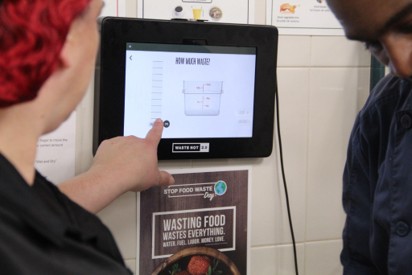
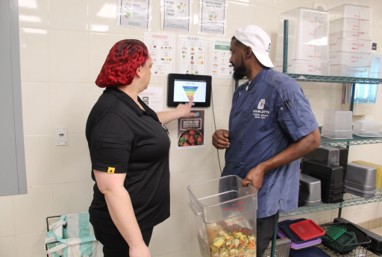
Waste Not 2.0 is a chef-focused tablet-based waste tracking tool that allows kitchen staff in South Village dining hall, Social 704, and the catering commissary kitchen to record the type of food waste generated in each dining hall. The ultimate goal is to reduce the amount of avoidable food waste (referred to as “red waste”) and ensure that the majority of food waste is unavoidable. Items like orange peels, eggshells, pineapple tops, and fat trimmings from meat are unavoidable and are referred to as “green waste.”
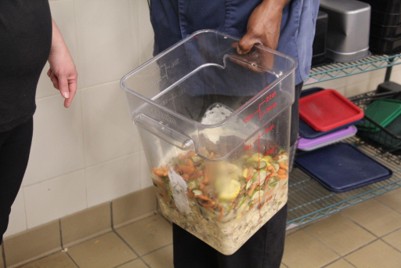
To record the waste, kitchen staff weigh the waste in clear plastic containers and record data on tablets mounted on the wall, as pictured here. Each dining hall has customized profiles for every kitchen station (i.e., deli, pizza station), helping pinpoint exactly where waste occurs.
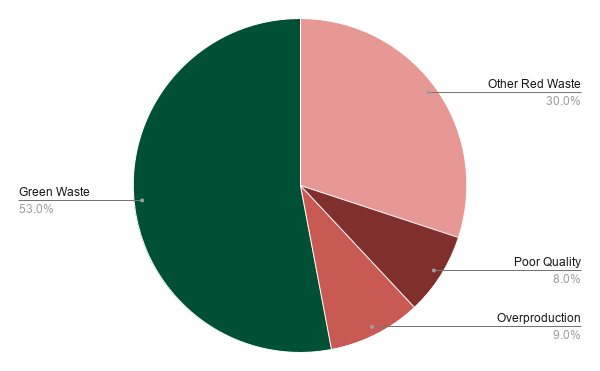
Red waste is broken into five subcategories that classify how it was generated, such as overproduction and poor quality. Green waste includes items like pineapple tops, banana peels, rinds, etc. that cannot be avoided. Of all waste generated, less than 33% should be red waste.
How UNC Charlotte is reducing waste
The charts pictured below show the ratios of waste types generated at UNC Charlotte from 2022-2023 compared to 2025-2026 academic years. Overall, the amount of green waste has increased, and the red waste has decreased. In the most recent academic year, 74% of waste recorded was green and 26% was red. Trends shown in these graphs also reflect factors such as an increase in student population, higher data accuracy, and the number of days that were recorded in each dining location.
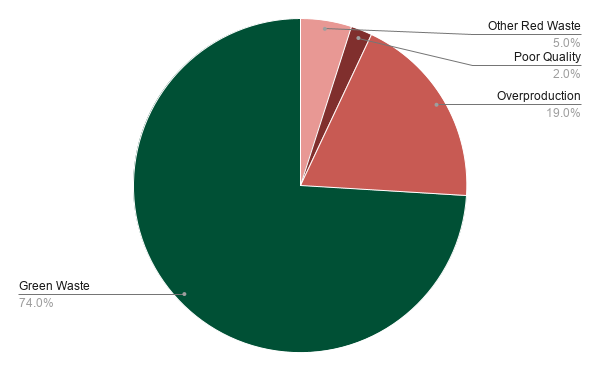
By recording these numbers, kitchen staff and managers can adjust food orders to avoid overproduction and reduce the amount of money spent on food. Chefs can reference data from past years to better understand and predict trends for future years. For example, during Halloween weekend 2025, there were 240 lbs of food waste produced due to overproduction. Chefs used this historical data and forecasting tools to predict trends for Halloween weekend 2026, where only 114 lbs of food waste from overproduction were generated, a 71% reduction.
All food waste, including food waste from back-of-house operations and plate waste from dining halls, is collected as compost, offsetting the carbon emissions and costs associated with sending it to the landfill. During the 2025-2026 academic year, an average of 1,919 pounds of compost was generated each day across campus. Composting food waste saves roughly 0.48 tons of carbon emissions per ton of food waste, avoiding the production of methane – a primary contributor to climate warming.
The compost is sent to an off-campus composting facility near campus, where it decomposes into a nutrient-rich soil amendment used in gardens, landscaping, and athletic fields in North Carolina. UNC Charlotte has composted since 2009, and efforts are expanding across campus, including paper-towel compost and countertop compost bins in staff breakrooms. Read more about composting on campus here.
Learn more about how UNC Charlotte dining services prioritizes sustainability on their website here.