Sustainability in every career: a reflection on the Student Sustainability Summit
Written by Justin Lindsay, Office of Sustainability EcoRep
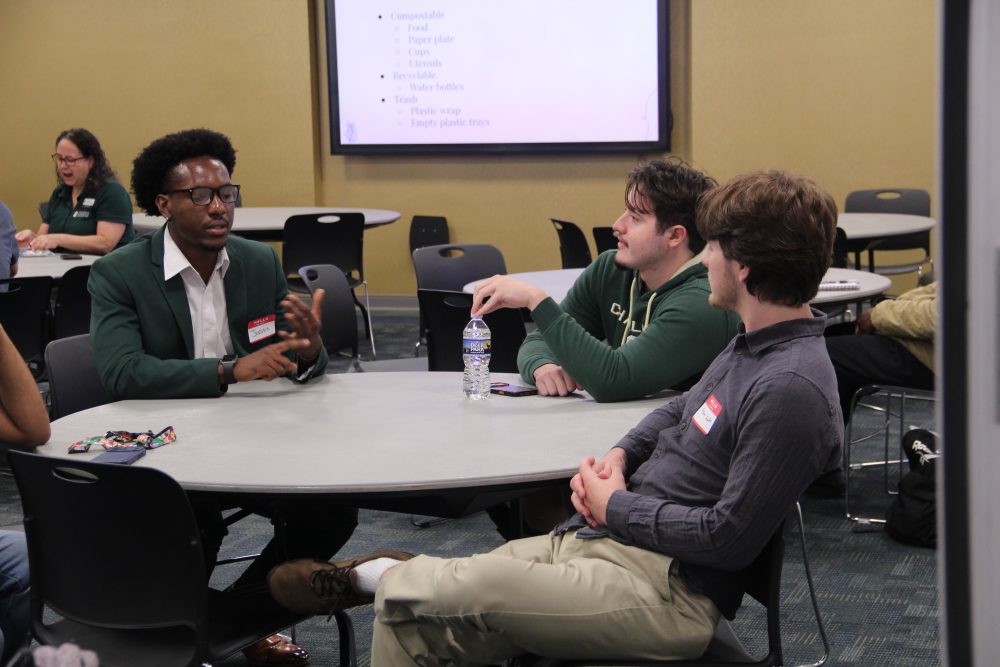
The Student Sustainability Summit was held on Saturday, October 17th, during the Office of Sustainability’s Campus Sustainability Month. In collaboration with the Student Government Association (SGA), this event engaged students with a variety of majors on incorporating sustainability into any career. The event featured panelists from different career backgrounds, including professors, city workers, and researchers. These professionals represented sectors such as conservation, policy, public health, business, transportation, and innovation. The summit also incorporated a career reflection workshop led by Jessica Kim, assistant director and industry specialist at the UNC Charlotte Career Center. To conclude the event, students were able to meet the panelists face-to-face and talk about their career history, aspirations, and goals during the featured networking hour.
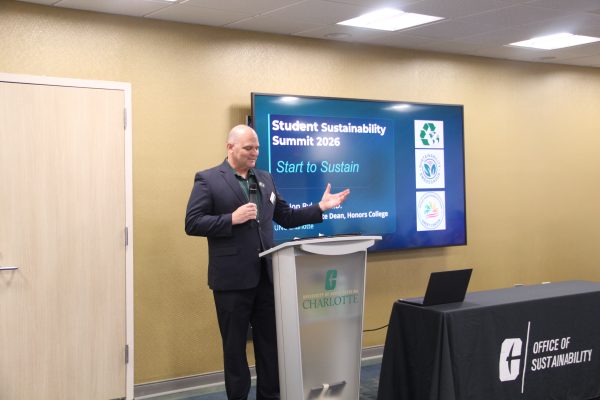
The keynote speaker for the summit was Dr. Erik Byker, interim associate dean of the Honors College and the co-director of the Global-ready Research and Equitable Education in Teaching (GREET) Center. One of his points included the Jagriti Cycle, which he learned about during a study in India, that includes the terms learn, unlearn, and relearn. Dr. Byker suggested that this concept should be applied when incorporating sustainability in our everyday lives to learn habits, unlearn those habits, and relearn sustainable actions and implement them into our daily lives.
conservation, policy, and public health panel
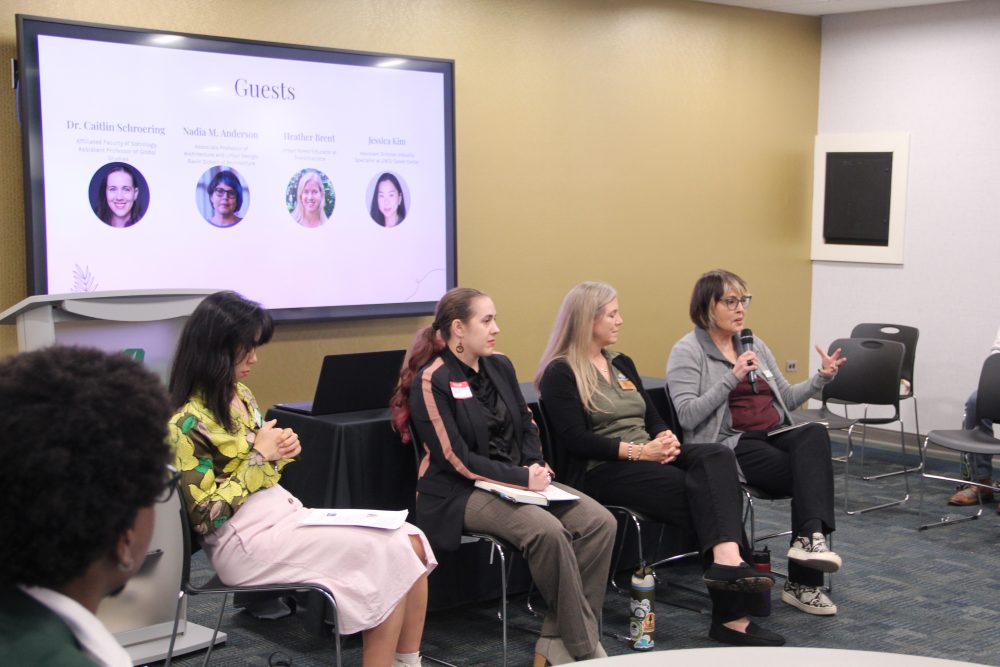
The first panel included:
- Dr. Caitlin Schroering, affiliated faculty of Sociology, and assistant professor of Global Studies
- Nadia M. Anderson, associate professor of Architecture and Urban Design, Ravin School of Architecture
- Heather Brent, an urban forest educator at TreesCharlotte
The panelists took a deep dive into conservation, policy, and public health by answering questions based on findings in their own research and work.
Schroering referenced her 2024 academic work, Global solidarities against water grabbing: Without water, we have nothing, emphasizing how we rely on technology such as AI to do the work for us compared to past times when civilizations created their own systems to access clean resources. Anderson and Brent answered questions relating to government involvement in policies and planning, incorporating sustainability into everyday practices. Anderson’s work encourages governments to invest in sustainable design and give agency to marginalized communities, allowing residents to have access to sustainable infrastructure and a healthier environment. Brent works closely with city officials and government entities to provide trees for newly built homes, improving air quality and aiding in the protection of urban forests and canopies that contribute to the health of our environment.
In closing, each panelist encouraged students to pursue careers that allow them to find their passion, leverage this passion to conduct research about what interests them, and find ways to get more involved within that field.
business, innovation, and transportation panel
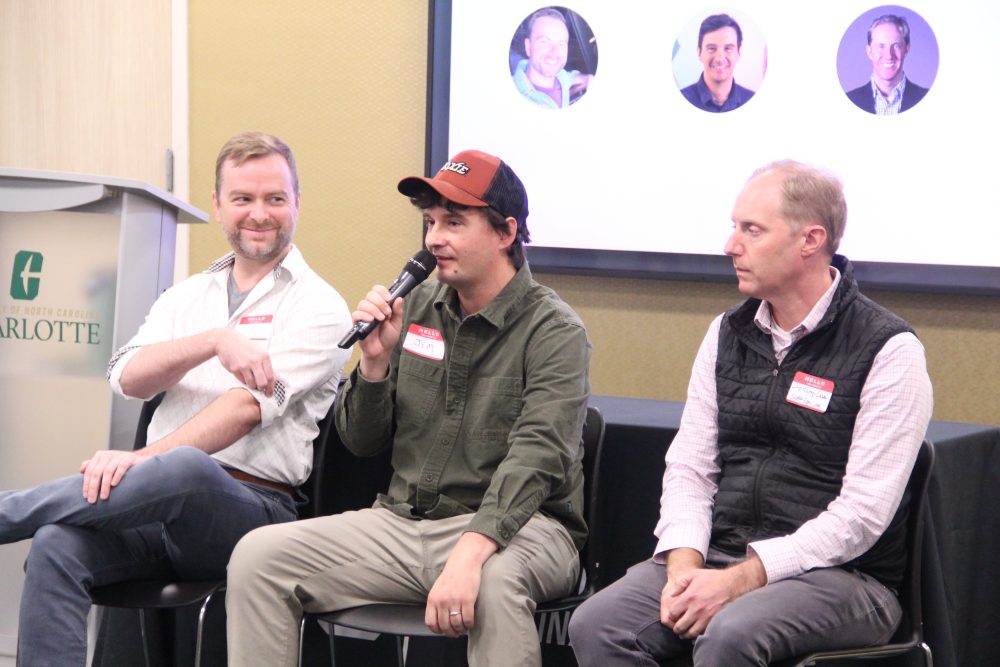
The second panel focused on speakers representing the business, innovation, and transportation industries and how they could be interwoven with the practice of sustainability. Represented in the second panel were:
- PJ McKenzie, transit energy analyst at Charlotte Area Transit System (CATS)
- Jim Middleton, sales development representative at Southern Energy
- Jeremy Losaw, manager of UNC Charlotte’s Super Fab Lab
For this section, each panelist explained their current projects or work that keeps them involved with sustainability. Losaw allows students to volunteer and get experience working in the Super Fab Lab through training and projects. Students are able to use 3-D printers and cutting machines to create sustainable and upcycled materials. Middleton emphasized that his career path was not what he expected. His first degree was in history, and his early dream was the classroom, but his career took a turn toward green business sales. McKenzie discussed how public transportation and CATS work to provide sustainable transportation in the Charlotte area. Electrifying a diesel fleet is challenging, but Charlotte is trying to bridge the gap by increasing its hybrid vehicles.
For the last portion of the event, Jessica Kim led students in completing the reflective workshop, My Career, My Impact, which built the foundation for student and panelists’ conversation. This led students to reflect on their own experiences and questions about sustainability and apply what they learned from the panelists to set goals for their future careers. The most notable part of the event was the networking hour, when students let their curiosity lead and asked panelists in-depth questions, deepening their interest in sustainable careers.
key takeaways
Ultimately, students were eager to absorb insights about the panelists’ career decisions and research. The panelists successfully reached students by expanding on their successes, failures, and challenges they faced. Relating to sustainability, the panelists elaborated on the sustainable work they have done so far, but it all led back to one idea: there is still more work to be done to protect our environment, encourage sustainable practices, and for businesses and governments to take responsibility for their environmental impact.
Personally speaking, one key takeaway that will remain with me is from Jim Middleton. As I mentioned earlier, he earned a degree in history and initially pursued a career in education, but he currently works in sales development. As college students, we have our career path and lifestyle planned out from the beginning: dream job, vacations, what cars we want to buy, and big houses. With predetermined plans, it’s harder to understand the importance of being open to change and understanding that life does not always go according to our plans. Our interests, goals, and career choices could change within a matter of months or years as we gain new knowledge, experiences, and face unexpected challenges. Middleton’s story reminds me that our success is not measured by how well we follow a pre-made plan, but it is about facing change, staying open to new opportunities and experiences, and embracing growth as we navigate life.